

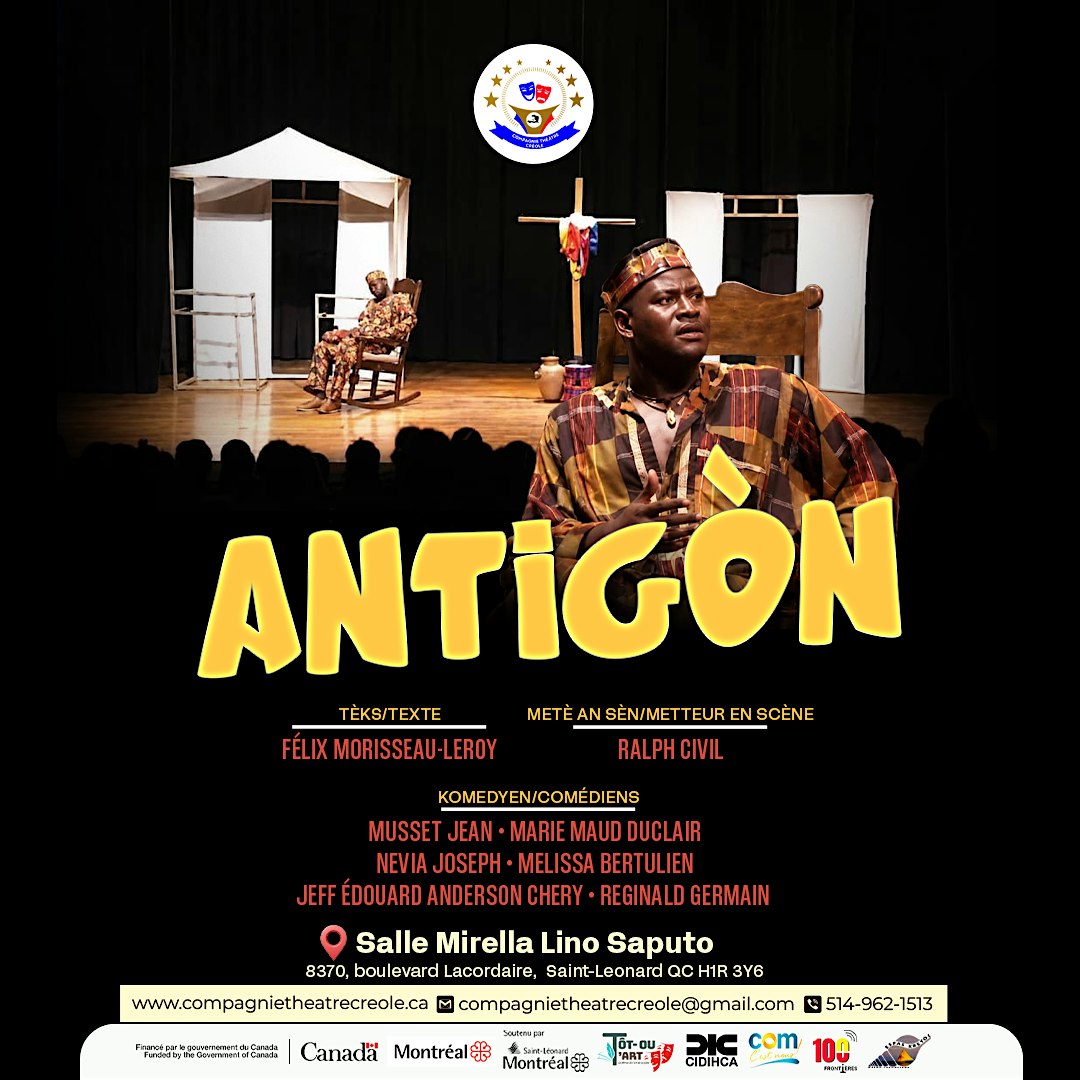
Antigòn Feliks Miriso Lewa
“Antigone” is a Creole adaptation of Sophocles’ play by Félix Moriso Lewa, a leading figure in Haitian theater. He transplanted the Greek myth into the rich soil of Haitian culture to give the story another dimension and make it accessible to the Creole audience.After a great war, Antigone’s brothers, Eteocles and Polynices, killed one another. The Creoles decided to hold an official funeral for only one of them, while he insisted on burying the other as well, because, to him, it would have been a betrayal.Antigone, who refused to accept this decision—which she deemed unjust and unfair—braved the danger and buried her brother. This act came to be regarded as an act of rebellion against the ruling authorities.Despite all his wise and mysterious advisors, the king refused to listen to him.This stubbornness led him far astray, until he killed a group of people, including Antigone, her fiancé, her young son Emon, and even his own wife. Unfortunately, he failed to see how his actions were plunging the country into too much turmoil.In this adaptation, Feliks Moriso Lewa transforms a universal fable into a profound reflection on justice, freedom, and human dignity, as well as a conflict between law and conscience.
*Antigone* by Félix Morisseau-Leroy
*Antigòn* is a Haitian Creole adaptation of Sophocles’ tragedy *Antigone*, written by Félix Morisseau-Leroy, a leading figure in Haitian literature and theater.The author transposes the Greek myth into a world inspired by Haitian culture, giving the work new power by making it accessible to Creole-speaking audiences.After a fratricidal war, Antigòn’s two brothers, Eteyoklès and Polinis, die after killing each other. The new ruler, Kreyon, decides to honor one of the brothers with an official funeral, while forbidding, on pain of death, that the other be buried, declaring him a traitor to the nation.Refusing to submit to a law she considers unjust, Antigone defies the ban and performs her brother’s funeral rites. Her action becomes an act of resistance against the arbitrary exercise of power. Despite the pleas of her loved ones and the warnings of the elders, Kreyon remains unyielding. This obstinacy triggers a series of tragedies that lead to Antigòn’s death, then to that of her fiancé Emon, the king’s son, and finally to that of the king’s wife. Too late, Kreyon realizes that his compassionless authority has led to his own downfall. Through this adaptation, Félix Morisseau-Leroy transforms a universal tragedy into a profoundly Haitian reflection on justice, freedom, human dignity, and the conflict between the laws of men and the laws of conscience.
